Why Bees Sting
How to come to terms with one of the most painful parts of beekeeping

By Herman Van Reekum
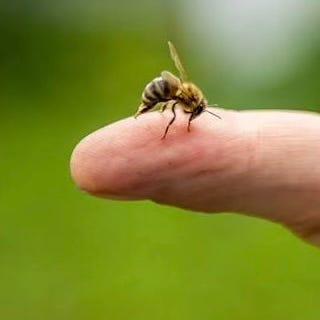
I get stung often, and every time it happens, I remind myself that it was my own fault. I was in too much of a hurry. I had not smoked the entrance properly before opening the hive. I had reached in without gloves because it was hot and I wanted the finer touch. The bee does what bees do when a large mammal reaches into their home without warning. She defends the colony even though she knows she will die. As worker honeybees always do when they sting a mammal, the barbed stinger tears out of her abdomen when she pulls away, and she dies within the hour.
The best way to avoid harm to the bees and to myself is to practice patience. The Reverend Lorenzo Langstroth, the American Presbyterian minister who invented the movable frame hive in 1851 and effectively founded modern beekeeping, understood this deeply. His 1853 book on beekeeping remains, more than 170 years later, one of the finest introductions to the craft ever written. On the question of stings, his most-quoted advice was simple. “Let all your motions about your hives be gentle and slow. Accustom your bees to your presence: never crush or injure them, or breathe upon them in any operation.” Beekeepers have been passing this counsel down for generations. The stings that follow when we ignore it have their own way of reinforcing the lesson.
This article is about why bees sting. It is also about what stings mean, biologically and behaviorally, and about what the recent science of bee cognition has to teach us about defensive behavior. Every sting is a communication. Reading it correctly is part of the craft.
What a sting actually is
Only female bees can sting. The honey bee stinger evolved from the ovipositor, the egg-laying tube of ancestral wasps. Over millions of years the ovipositor became modified in one branch of the wasp family into a specialized defensive weapon: barbed shaft, venom sac, coordinated musculature to drive it in. Because males never had ovipositors, drones cannot sting. Neither can any male bee of any species.
The honey bee worker is the only bee whose sting is fatal to herself. Her stinger is barbed. When she stings something soft (mammalian skin, cloth), the barbs anchor the stinger in the target. When she pulls away, the stinger tears out of her abdomen along with the venom sac, the coordinating musculature, and part of her digestive tract. She flies away, seemingly intact, but the damage is fatal. She lives minutes or a few hours at most. This has struck philosophers and biologists for centuries as a strange evolutionary bargain. Why would a species evolve a defensive weapon that kills the defender? To me it is one of the best examples of altruistic behaviour in the natural world, and it is admirable.
Bumble bees, in contrast, can sting repeatedly. Their stingers are less strongly barbed and can be withdrawn without damage. Bumble bees are also famously docile, rarely stinging even when handled. Solitary bees, of which there are thousands of species, can sting but almost never do, because the individual bee has no colony to defend and every reason to avoid confrontation with something much larger than herself. Wasps, hornets, and yellow jackets, which are often confused with bees, can also sting multiple times and are considerably more aggressive on average than any bee species. When a person is stung by “a bee” at a summer picnic, the odds are actually good it was a wasp.
The venom itself is a cocktail. Melittin is the primary pain-causing compound, a small peptide that disrupts cell membranes. Phospholipase A2 amplifies inflammation. Histamine causes swelling. Apamin acts on the nervous system. And, critically for beekeepers, isoamyl acetate is released along with the venom as an alarm pheromone. It smells like ripe bananas and it marks the sting site as a target for other bees to attack. This is why a single sting can escalate quickly if the beekeeper does not step away and give the colony time to calm down.
Why bees usually don’t sting
Most people, if they thought carefully about it, would recognize that bees are actually surprisingly calm creatures. Consider a honey bee working a flower. She has landed on an unfamiliar shape. Other bees are landing nearby. Humans and animals move through the field around her. She does not sting any of them. She works her flower, collects what she came for, and flies home. Most human-bee encounters end this way, with the bee ignoring the human entirely. This is why urban backyard beekeeping works.
The reason is that stinging is a colony defense behavior, not an individual defense behavior. A foraging bee away from her hive has almost no reason to sting. She is exposed. She is alone. Her death would not protect anything. She is much better off avoiding conflict and returning to the colony with her nectar or pollen. The only time a foraging bee will sting is when she feels her own life is directly threatened, most commonly when she gets trapped in clothing or hair and cannot escape. Even then, most foragers will try to get away before resorting to their fatal weapon.
A bee at the hive entrance is a different creature. She is a guard. Her job is to challenge intruders. She is prepared to sting and to die doing it. This is the bee you encounter when you approach a colony. If you understand what she is doing, you can work with her. If you do not, she will teach you.
Guard bees are middle-aged, roughly 18 to 21 days old in the summer. Honey bee workers cycle through a series of roles over their six-week lifespan. They start as cell cleaners, become nurse bees feeding larvae, then middle-aged workers building comb and processing honey, then guards at the entrance, and finally foragers who leave the hive to collect nectar and pollen until they wear out their wings and die. The guard bee at the entrance has not yet begun the punishing work of foraging. She has developed venom, wing strength, and behavioral readiness. If she dies defending the colony, the loss is real but bearable. She is old enough to do the job and young enough to do it well.
When they do sting
Defensive stinging is triggered by a combination of specific factors that experienced beekeepers learn to read. Understanding these factors is the difference between a calm inspection and a painful one.
Threats to the colony are the primary trigger. Approaching the hive, opening it, disturbing the frames, breathing on the bees, blocking their flight paths, or generating vibration all register as potential threats. The bees respond in proportion to the perceived danger. A gentle approach with smoke and slow movement causes minimal response. A rushed approach without smoke, with fast movement, in inappropriate clothing, causes something quite different.
Alarm pheromones amplify everything. The moment one bee stings, the chemical signal spreads. Other bees orient toward the sting site and prepare to defend. A single missed step can escalate into dozens of stings within a minute if the beekeeper does not respond quickly by stepping away and letting the pheromones dissipate.
Weather affects defensive readiness in ways that surprise new beekeepers. Bees are more defensive in humid conditions before thunderstorms, in overcast weather, in cold temperatures, and late in the afternoon when foragers are returning to a full colony. Working bees in bright morning sun with a light breeze, when most foragers are out working, is one of the calmest possible conditions. Working them in the late afternoon of a thunderstorm approach is one of the most defensive.
Colony health matters enormously. A colony under Varroa pressure, pesticide exposure, or nutritional stress is more defensive than a healthy colony. The relationship is causal. Which brings us to the science that has been accumulating over the past decade.
Avoid stressing your bees
In 2011, Melissa Bateson and colleagues at Newcastle University published a paper showing that stressed honeybees exhibit pessimistic cognitive biases. We covered this research in “The Optimistic Beekeeper” earlier this month. The essence of the finding: bees that had been agitated in a mechanical shaker interpreted ambiguous cues as threats more often than untreated bees. Their neurochemistry showed reduced serotonin, dopamine, and octopamine, the neurotransmitters associated with mood regulation across the animal kingdom. The shaken bees were, in a functional sense, more anxious than their untreated peers.
Reading the Bateson research alongside my own experience of getting stung, I have come to think it explains a lot. A colony under chronic stress (from mites, from pesticides, from disease, from nutritional deficiency) is a colony whose defensive threshold has dropped. Ambiguous cues that a healthy colony would interpret as safe get interpreted as threats. The bees sting more readily. They stay agitated longer. They respond to disturbances with a level of intensity that is disproportionate to the actual threat.
This week’s digest included another piece of evidence in the same direction. The Zhou, Ingraham, Barron et al. paper in the Proceedings of the National Academy of Sciences documented that bumblebees produce orofacial reactions to tastes that mirror the “liking” and “disliking” responses established in mammals. Bee brains produce affective evaluations. Whatever we want to call it, something is happening inside the bee that shapes her response to the world. Defensive stinging is one of the visible outputs of that internal state.
The practical implication for beekeepers is direct. When a colony becomes suddenly more defensive than usual, something has changed. It might be weather. It might be a lost queen. It might be a pest or disease outbreak I have not yet seen with my eyes. It might be pesticide exposure from a nearby farm. The stinging behavior is a diagnostic signal as much as a nuisance. Reading it correctly is part of the craft.
Why die to sting
The evolutionary question that has puzzled thinkers since Darwin is why a worker bee would evolve a defensive behavior that kills her. The answer connects to the deep biology of the honey bee colony as a superorganism.
A worker honey bee does not reproduce. She is essentially sterile. Her genetic future depends entirely on the survival of her sisters, particularly the queen, and on the production of new queens and drones that will pass on the colony’s genes. The colony, not the individual worker, is the unit of natural selection. When a worker sacrifices herself to protect the colony, she is protecting the genetic future of her kin. The math works out. Her death is meaningful because it defends something much larger than herself.
Bumble bee colonies operate differently. They are annual rather than perennial. Their workers do not develop the kind of colony-level defense investment that honey bees have. Bumble bee stingers evolved without the same barbs, allowing repeated stinging, but the bumble bee is also much less likely to sting in the first place. The evolutionary strategy is different because the colony biology is different.
The honey bee worker who dies stinging me on the back of my knuckle is participating in a strategy that has kept her species successful for at least 25 million years. She is doing what she is supposed to do. My job, as the beekeeper who has invaded her home without proper preparation, is to accept the sting as the price of my own carelessness and to do better next time.
Sting rate and colony health
Every experienced beekeeper eventually develops an intuitive sense of colony mood. You know which of your hives are calm and which are hot. You know which lines you have selected for gentle temperament and which have inherited from an unruly queen. You know which yards produce sting-free inspections and which require full gear even on your calmest days.
The sting rate is a real diagnostic. A colony that is suddenly more defensive than it was last week has changed in some way. Queen problems, disease, mite loads, pesticide exposure, and nutritional stress can all show up as increased defensiveness before they show up as anything else you can see. The Bateson research explains why. Stressed bees have shifted neurochemistry. Defensive behavior is one of the visible outputs of that internal state.
The reverse is also true. A colony that has consistently calm bees is often a colony that is thriving. Good nutrition, low disease load, healthy queen, appropriate space, adequate forage all correlate with calm defensive behavior. Beekeepers who select for gentle stock are doing more than choosing for their own comfort. They are selecting for the underlying colony health that produces calm behavior in the first place.
What experienced beekeepers know
The practical wisdom of beekeeping about stings has been remarkably consistent for the past 170 years. Langstroth’s advice from 1853 remains largely intact. Move slowly. Use smoke. Choose your timing. Wear appropriate gear when the situation calls for it. Do not breathe directly onto the bees. Do not crush them accidentally. Accept that occasional stings are part of the craft. Learn from each one.
Every beekeeper I know operates by this standard. When we get stung, we ask ourselves why. The answer, most of the time, involves something we could have done differently. The reflection is not self-blame so much as a recognition that the bee was following her nature and we were failing to accommodate it. The relationship works best when we do the work of understanding what the bees need, and it breaks down when we do not.
A sting is a communication rather than a punishment. It is telling you that something in the interaction between you and the colony has gone wrong, and it is asking you to slow down, reconsider, and try again.
Sources: L. L. Langstroth, Langstroth on the Hive and the Honey-Bee (1853, subsequent editions). Bateson, Desire, Gartside, and Wright (2011), Current Biology. Bee Spaced archive material on colony stress and cognition (January–July 2026). For links to related material, visit globalmobility.substack.com.
This is part of “From the Archive”, a series where I dig into topics surfaced by the Bee Spaced weekly digest. Each week the digest brings in research papers and news articles. Sometimes one of them grabs me and won’t let go. This series is what happens when I pull on the thread.